Background
I wrote this song in 2017 after struggling to come up with ideas for new songs. After a slightly manic session of joyful slides, palm mutes, scrapes, bends and other guitar-specific things in the rocking key of F# I decided to only focus on movements that felt fun to play.
From there I wrote the opening riffs and the rhythm section during the solo. The song lay dormant for a while until Youtube recommended this video and I went “Hard Yakka, of course!”. I often find that I need to name a song in order to understand what it’s about and finish it. It turns out this one is a trial for guitar players.
As a bonus I’d like to show you the first riff I wrote but didn’t include:
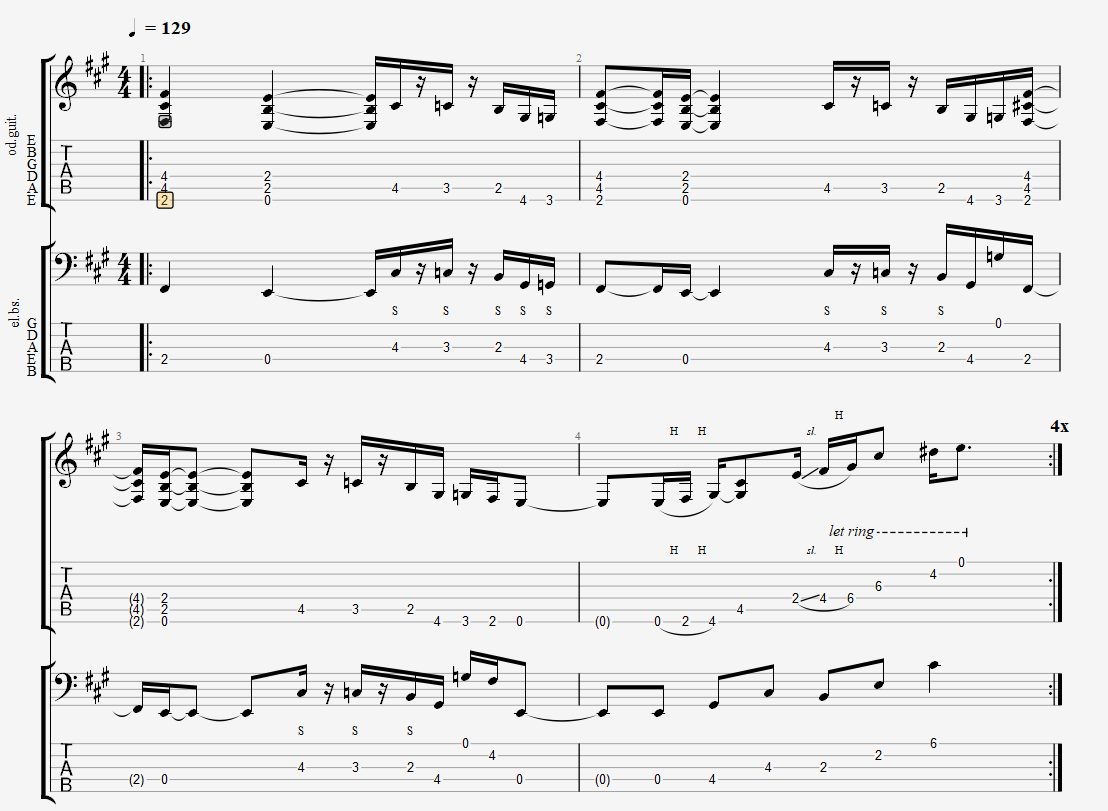
This one also features a shrinking length of the first beat as well as an ascending lick at the last bar. I really like this riff and hope to use this in another context.
Performance notes
This song is full of dotted eight-notes! I really tried to make it fun to play so there are a lot of guitar-specific things that I enjoy a lot.
I’ve tried to indicate the fingering of things for both hands but you are of course free to play things however you want.
Lead
The first thing to pay attention to is bar 36. Here you have a D# that lasts one eight note and one 16-note triplet. It looks more difficult than it is and I think that the trick here is to learn how the rhythm sounds..
Bars 44, 76 & 113: The most difficult part here is actually to hit the high C# on the following bar. I recommend practicing slowly section by section at first before you put the previous, current and following bars together. Once again rhythm is key here. Everything will fall into place once you understand what to accent.
Bars 63 & 64: These ones took me forever and I will probably simplify them when I play live. The string skipping gets really tough and there is really no way around it. It’s not much help other that letting you know that I feel the pain as well
Bar 91: I bend with my ring finger while holding over the harmonic with my pinky and play the following F# with my middle finger.
Bars 95 & 96: These are my favorite from the entire song. Once again I suggest practicing only the rhythm first. I tap with my middle and ring-fingers and hammer on from nowhere on my fretting hand. It’s really important that you mute all the strings that you are not playing because this could easily turn into a mess. I really like the idea of tapping on strings without pulling off and instead hammering on
others with the fretting hand. There is a lot more to explore here and I hope you find it as much fun as I do.
Bar 97: As with the previous bars it’s important to mute the strings you are not playing while tapping.
Bars 98-99: I’ve tried different fingerings here and would recommend what I’ve written. If these bars are hard I would suggest playing 16-notes for two bars with only scratches and then trying to accent just the notes that need to be accented. You could also try just scratching on a single string for these bars. The most important part is that it’s rhythmically solid and that there is a clear difference between scratched and fretted notes.
Bars 117, 118 & 119: It can be surprisingly difficult to jump from the 16th fret to the 9th between bars 117 & 118. Try looking at the place you are going to land (the 9th fret) before you start moving your hand. Bars 118 & 119 contain some awkward fingerings using your index finger. Just know that It’s perfectly doable.
Rhythm
Bars 8 & 16: This is a bit tricky and I suggest practicing it half a bar at a time. It can also be useful to practice the transition from bar 8 to 9 since your hand has to travel quite far. Once again make sure you physically look at the place you are going to place your fingers at (fret 2) before you start moving your hand.
Bars 83-101: Really learn the rhythm here. There are a lot of dotted eight-notes but there are other things as well. Make sure you also practice with the bass track since it might throw you off if you practice without it. Guitar and bass do a sort of call and response thing that should be heard as one part.
Bar 120: The powerchord change to the B major is really fast and might take some practice if you are not used to these sorts of things.
You can listen to Hard Yakka here:
Personnel
Drums: Nick Acker
Bass: Raúl Vicente
Everything else: Elder Ozone
Gear
Picks: Dunlop Max-Grip Jazz III
Amp: Neural DSP Archetype: Plini for lead Neural DSP Archetype: Nolly for rhythm
and Neural DSP Parallax for bass
Guitar: Schecter Hellraiser C1FR from 2007
Bass: Fender 5-string Jazz Bass
Synth: Vital and Elektron Model: Cycles
FX: Portal by Output for soundscapes throughout the song